


Great business ideas are everywhere, but most startups fail. Why? Because many entrepreneurs skip the idea validation process.
This guide walks you through how to validate a business idea in six simple steps. You’ll test your business concept without spending too much time or money.
By following this process, you’ll see if your idea has potential or needs improvement, helping you avoid becoming another failed startup.
Best Website Builders to Test and Validate Your Business Idea Online
| Provider | User Rating | Recommended For | |
|---|---|---|---|
 | 4.6 | Beginners | Visit Hostinger |
 | 4.4 | Pricing | Visit IONOS |
 | 4.2 | Design | Visit Squarespace |
1. Identify and Define Your Problem Statement

Articulate the Specific Problem You’re Solving
A successful business starts with a clear problem. A vague idea won’t work. Saying, “People need better fitness options,” is too broad. Instead, be specific: “Busy professionals in cities struggle to find quick, effective workouts that fit their unpredictable schedules.”
Write down the problem you see. Then ask yourself, “Why does this matter?” Keep asking until you find the real issue. This method, called the “5 Whys,” helps uncover the root cause.
For example, if you think “People waste food,” dig deeper. Maybe the real issue is, “People don’t have an easy way to track food before it expires.” That’s a problem worth solving.
A strong business idea is built on problems that happen often, are frustrating enough for people to seek solutions, and have paying customers willing to spend money on a fix.

To dive deeper into startup planning, check out how to start a startup.
Determine Who Experiences This Problem Most Acutely
Not everyone feels the problem the same way. Some struggle with it more than others. These people are your best early adopters—the ones most likely to try your business idea first.
Go beyond age and location. Focus on behaviors and motivations. A 35-year-old urban professional who orders takeout five nights a week because cooking feels stressful is a clear target customer. That’s better than just saying “busy people who don’t cook.”
Figure out if your idea has enough demand by using these market size levels:
- TAM (Total Addressable Market): Everyone who could use your product.
- SAM (Serviceable Available Market): Those you can realistically reach.
- SOM (Serviceable Obtainable Market): Your first paying customers.
This will show if your idea is worth pursuing.
Assess Problem Severity and Frequency
Rate your problem in three ways: urgency (how soon does it need fixing?), importance (how much does it matter?), and frequency (how often does it happen?).
Problems that score high in all three make the best business opportunities. A daily, urgent, and important problem pushes people to buy faster than a minor inconvenience.
Is your product idea a “vitamin” (nice-to-have) or a “painkiller” (must-have)? Painkillers attract paying customers more easily and keep them longer.
2. Conduct Customer Discovery Interviews
Prepare Your Interview Strategy
Conduct customer validation interviews to help you test if your business idea solves a real problem. These are not sales pitches or casual chats. They are structured conversations to explore customers’ pain points and needs.

Prepare an interview script with open-ended questions like “Walk me through how you currently handle [problem area]” or “What’s the most frustrating part about [activity]?” Avoid leading questions that bias responses toward your solution.
Aim to conduct at least 20-30 interviews for meaningful patterns to emerge. Fewer than that, and you risk making decisions based on outliers rather than trends.

Find and Approach Potential Interviewees
Finding people to interview might seem tough, but there are easy ways to start. Begin with your network. Then, reach out to online communities, social media groups, and industry forums.
Use a short screening questionnaire to make sure you’re talking to the right target customers. If your business idea is for small restaurant owners, don’t interview corporate managers. Their pain points will be different.
When contacting strangers, be clear about your goal. Respect their time. A 15-20 minute conversation is often enough to gather honest feedback and useful insights. Keep it simple and focused.
Extract and Analyze Key Insights
After your interviews, look for common themes. What pain points came up the most? How do people currently solve the problem? Would they pay for a better product or service?
Write down direct quotes from customers. Strong emotions in their words show how big the problem is. These quotes will help shape your marketing strategy later.
Use these insights to adjust your problem statement and target audience. You might find that the real issue is different from what you first thought—or that a new target market segment needs your solution more.
3. Analyze the Competitive Landscape

Identify Direct and Indirect Competitors
Every business idea has competition, even if it’s not easy to spot. Direct competitors solve the same problem as you. Indirect competitors offer different solutions or meet related needs.
Don’t ignore DIY solutions and workarounds. Sometimes, your biggest rival isn’t another company—it’s how people already handle the problem without a formal product or service.

Make a detailed list of competitors. Look at their pricing, features, and target customers. Use Google, SimilarWeb, and Crunchbase to find existing products you may have missed.
Evaluate Competitor Strengths and Weaknesses
See what competitors do well and where they fail. Read customer reviews on Trustpilot, G2, or Amazon. Look for complaints and needs that no one is solving.
Pay close attention to how competitors sell themselves. What benefits do they highlight? What words do they use to describe their product or service? This shows how the target market thinks about the problem.
Check their business model. Do they use subscriptions, one-time purchases, or freemium plans? Spotting these trends can help you find ways to stand out.
Define Your Unique Value Proposition
Your unique value proposition (UVP) should explain what you offer, who it’s for, and why it’s better than the competition. A successful company doesn’t just copy others—it fills a gap in the market.
A strong UVP highlights a clear advantage. Maybe your product has a feature your competitors lack, a better way to solve the problem, or serves an underserved market segment.
Use these insights to refine your business idea. If needed, adjust your approach to secure a stronger market position and attract target customers.
Check out our guide on how to decide which business to start for inspiration.

4. Build a Minimum Viable Product (MVP)

Determine the Simplest Version of Your Solution
The MVP approach means building the simplest version of your product or service that still solves the core problem. It’s not about making a half-finished product. It’s about focusing on what truly matters.
Start by listing every possible feature. Then, cut everything except the essentials. Ask yourself: “What’s the bare minimum this needs to work?” Save extra features for later.

This idea validation process saves time and money while helping you learn faster. A complex product takes longer to build and makes it harder to see what the target customers need.
Select the Right MVP Format for Your Idea
Different business ideas call for different MVP approaches. Digital products might start as simple landing pages, wireframes, or prototypes built with no-code tools or AI tools for MVPs. Physical products could begin as 3D-printed prototypes or small-batch productions.
Some businesses can even validate using a “concierge MVP,” where you manually deliver the service before building any technology. This approach, pioneered by companies like Zappos (which initially just purchased shoes from local stores when orders came in), lets you test demand with minimal upfront investment.
Choose the MVP format that balances speed, cost, and learning potential for your specific idea. The goal is to get something in front of real users as quickly as possible.
Set Up Your Online Presence
Even the simplest business ideas need a website to reach potential customers and test actual demand. Once you create a website, is like having your own digital storefront. It explains your concept, showcases your Minimum Viable Product (MVP), and collects real feedback from visitors.
Web hosting matters. If your site crashes, loads slowly, or goes down, you lose paying customers and get false market validation data. Choosing the best web hosting service keeps your site running smoothly, so your business stays visible during critical testing periods.
For e-commerce business ideas, an online store helps test product interest with pre-orders or early sales. Many platforms make setup easy, letting you launch in hours, not weeks—getting you to market success faster.
5. Test Market Demand with Real Customers
Implement Pre-Sales or Crowdfunding Campaigns
The ultimate validation comes when people vote with their wallets. Pre-sales campaigns let you test their willingness to pay before fully developing your product or service.

For physical products, platforms like Kickstarter or Indiegogo provide built-in audiences and payment processing. For services or digital products, simple payment forms on your website can accomplish the same goal.
Set clear targets for what constitutes validation. Is it 100 pre-orders? Raising $10,000? Reaching a 5% conversion rate? Having concrete goals helps you objectively evaluate results rather than moving the goalposts to fit your desired outcome.
Even with no capital, you can start an online business with no money.
Run Small-Scale Paid Advertising Tests
Paid advertising offers a controlled environment to test market response to your offering. Even with a small budget of $100-300, you can gather meaningful data about interest levels and messaging effectiveness.
Create targeted ads on platforms where your audience spends time—Facebook, Instagram, LinkedIn, or Google, depending on your target customer. Test different value propositions and messaging angles to see what resonates most strongly.
Track metrics like click-through rates, landing page conversions, and cost-per-lead. These indicators help you understand both market interest and the efficiency of your customer acquisition approach.

Hostinger: Top Website Builder for Beginners
Measure and Interpret Customer Engagement
Beyond direct sales metrics, analyze how potential customers engage with your MVP. Are they signing up for updates? Spending time exploring your offering? Sharing it with others?
Set up basic analytics to understand user behavior. Tools like Google Analytics or simple email tracking can provide insights into engagement patterns without complex implementation.
Establish benchmarks for what success looks like at this validation stage. Industry averages can help, but also consider your specific context and business model when interpreting results.

6. Gather and Implement Feedback
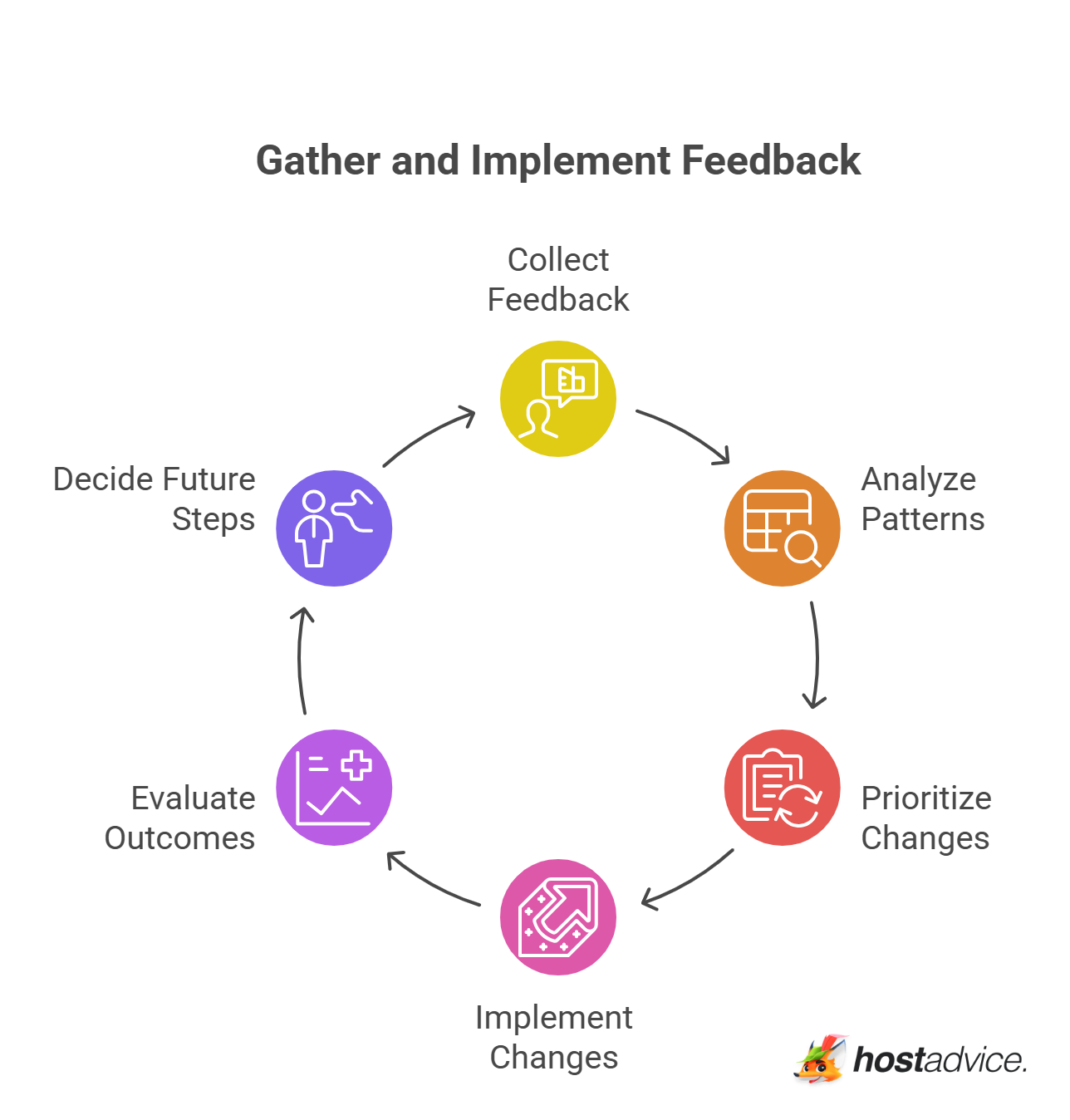

Collect Structured Feedback from Early Users
Early users give feedback that helps improve your product. Set up simple ways to collect their thoughts. Use surveys, follow-up interviews, or user testing.
Ask clear questions about their experience. Find out what they liked best (“What was most useful?”) and what needs work (“What was confusing or frustrating?”).
Watch how they use the product. Actions matter more than words. People often say they love one feature but use another the most. Focus on what they do, not just what they say.
Analyze Feedback Patterns and Prioritize Changes
As feedback comes in, watch for repeating themes instead of reacting to every single comment. If five users mention the same problem, it’s likely a real issue that needs fixing.
Separate urgent problems from small annoyances. Fix what blocks the product from working first. Nice-to-have features can wait for later updates.
Use this feedback to shape your market validation roadmap. Plan improvements based on real user needs. This way, you make smart changes instead of reacting to every new suggestion.
Pivot or Persevere Decision
After testing your business idea, you must decide what’s next: pivot, persevere, or walk away.
Persevere if you’ve found strong market validity—your target customers want the product or service, and they’re willing to pay. Pivot if the idea validation process showed interest but not enough actual demand. This could mean adjusting your business model, reaching a new target audience, or fixing key pain points.
Base your choice on real feedback, not emotions. It’s easy to cling to your initial idea, but smart entrepreneurs follow market research, even when it means changing direction.
Conclusion
Startup idea validation is not a one-time task. It’s a process of testing, learning, and improving.
By following these six steps, you increase your chances of building something people want. Even if your idea fails, you gain valuable insights that help you avoid costly mistakes.
The path to success is rarely straight—listen to real feedback, adapt, and keep refining until you find what works.

Next Steps: What Now?
- Build Your Website: Create a website to showcase your business idea and start gathering feedback.
- Choose Reliable Web Hosting: Choose a web hosting provider to keep your site running during market validation.
- Analyze Market Demand: Conduct market research to understand your target market segment and study existing products.
- Run Paid Ads: Launch low-budget paid ads on search engines or social media to see if your target audience engages with your product concept.
Further Reading & Useful Resources
- What Is a Sole Proprietorship?
- How to Start a Sole Proprietorship?
- How to Start an LLC?
- How Much Does It Cost to Start an LLC?
- How to Get a Business License?
- How to Start an E-commerce Business
- What Is a Niche Market
- Strategies for E-commerce Marketing
- How to Build an E-commerce Website
- Business Models In E-commerce
- Types Of E-commerce
- E-commerce Payment Methods
- Digital Marketing: Strategies for Business Growth
- Digital Marketing Tools to Simplify Your Business

