Online courses are easier and more convenient to learn from anywhere. This means learning how to create an online course to sell is the key to more opportunities for educators.
In this article we’ll show you how to create online courses and market them to the right audience. This step by step guide also lists the top platforms to sell these courses.
The online course market will be worth billions by 2025.
You can only teach people online by choosing the right topic and platform.
You must create high quality, engaging content to attract and keep students.
You must market your courses through the right channels to reach your audience.
You can get feedback and testimonials from students to gain insights.
Understanding the Market and Your Audience
Online education is easy and affordable for people around the world. This industry gives educators a chance to share their knowledge with others around the world.
You can also earn a steady income. Online course creation allows you to prove yourself as an expert. It’s perfect for a source of income.
Current State of the Online Course Market
The online education sector is growing fast. This sector will be worth so much in the coming years if this growth continues. This growth is because of the increasing demand for easy and accessible learning options.
Plus the creator economy in online content. This economy has enabled people to share their expertise and build online businesses.
Part of this booming economy is creating and selling online courses. This economy has also given an opportunity to make money as a student.
Who is Your Ideal Student
The first step in online course creation is to study and understand your audience. Your audience is the people or students you’re creating this course for. They have needs, challenges and goals that require learning.
You must put yourself in their shoes to tailor your course content to their needs. This is the only way to create a valuable learning experience.
Here are some key points to help you identify your audience:
Experience with online learning: Know if your audience is familiar with online courses. You may need to adjust if this is their first time.
Learning goals: What do they hope to achieve by taking your course.
Time commitment: Know how much time your students can dedicate to their classes.
Prior knowledge: Know their level of knowledge. This will help you know where to start.
Preferred learning styles: Know which learning style they prefer. Some students may prefer visual or auditory learning. Some may even want kinesthetic learning.
Knowing this will help you create the perfect course for your audience’s needs. This way you can run a successful online course from anywhere.
Choosing a Profitable Course Topic
The next step is to choose a profitable online course. This means choosing a course topic that meets your audience’s needs. This step is the key to determining what course you’ll be creating. Understanding how to create an online course also means proving your expertise.
Validating Your Course Idea
You must choose an online course idea with high market demand. This demand means many people want to learn this subject.
But you must have the knowledge and expertise to teach the topic. You can teach any course online. You can even make money from Canva by teaching design courses.
But it’s best to be sure your audience has genuine interest in it. This means testing the market demand to confirm the interest. One effective method is to create a Minimum Viable Product (MVP). This is a simple and easy version of your course, focusing on specific areas.
You can offer this version to a small group of potential students to gauge their interest and gather feedback. Another method is to host a free course webinar for potential students.
This will allow you to interact with them and answer their questions. You can use their responses to learn more about their needs and expectations.
Finding Your Niche
You’ll be more successful with a profitable niche. Finding and choosing a niche allows you to tailor your course content to a specific audience. You can also focus on your passion or area of expertise. This niche will be your unique selling point.
Here are some ways to help you find a profitable niche:
Use keyword research tools: Fine niche-related keywords using specialized tools. You can use Google Trends to find popular topics and keywords related to your expertise.
Explore online communities: Check online forums and communities to get valuable insights. An online community can tell you about your target audience’s challenges and interests.
Follow industry leaders: Check the social media accounts of leaders in your industry. Use these channels to see what they’re talking about and sharing.
These will help you research and analyze market trends. This way you can find a niche that’s profitable and suits your expertise.
Creating High-Quality Course Content
Next step is to create your course content based on your chosen idea. This stage involves defining the result of enrolling in your online school and structuring your course. It also covers developing engaging class materials.
Defining Learning Outcomes
Every successful online course has its student’s learning outcomes. The outcomes define what they’ll be able to do after completing your course. You need clear definitions for your learning outcomes to develop your course.
You can use the ABCD approach to write your learning outcomes. This includes:
Audience: Who are your learners.
Behavior: What can they do after completing the course.
Condition: Under what circumstances can they prove themselves.
Degree: What level of accuracy can they use this skill.
Structuring Your Course
You must structure the whole course so the learning process flows smoothly. Outline your course content first. Then divide it into how many lessons and modules it has. Each lesson should cover a part of the course. Each module should focus on a topic or theme.
Create a storyboard to imagine how your course will flow. This will help you organize your course curriculum. You’ll also use this to follow the course outline from one topic to another.
You can follow these tips to create an engaging course:
Break down complex topics into smaller chunks that people can understand.
Use different content formats to cater to different learning styles and keep your students interested. You can use videos, text, downloadable resources and interactive quizzes.
Set clear learning objectives for each lesson. This will help students know what they’ll learn and the results to expect.
Creating Engaging Course Content
Your students can only succeed if your course content is high quality. You can do this by delivering valuable information in your course materials. Make sure your delivery is engaging and provide a detailed course description to grab your student’s attention.
You can use any content format you want. If you’re using video, make sure the setup, shooting and editing is top-notch. Use good lighting and clear audio, and minimize distractions in the sound and visuals. Engage your students with various instructional design methods.
Also, build an online community to enhance the learning experience. This will be a private space for students to interact with each other and share their experiences. This will make them feel they belong and get motivated.
Top 12 Platforms to Host and Sell Your Course
Now that your course content is ready, you need to host and sell it on a platform. You can do this on two platforms. These are online course marketplaces and standalone course platforms. Both platforms will make selling your online course easier. But first, let’s explain them in this section.
Course Marketplaces
Online course marketplaces are a convenient and easy way to reach a large audience at once. They have a large student base and handle the technical aspects of course hosting. They also handle marketing to promote your course to the right audience. However, you have less control over branding and pricing.
Udemy is a great option for launching your first course, especially if you’re new to online teaching. The platform walks you through the course creation process and helps you reach a large built-in audience through its marketplace. You can also access promotional tools to boost visibility and sales. Udemy’s main features include:
Built-in student marketplace
Step-by-step course creation tools
Promotional and discount tools
Video hosting and analytics included
Pricing: Free to join; Udemy takes a commission on course sales (typically 50%, or 3% for instructor-promoted sales).
Ideal for: Beginners who want help creating and selling their first online course with minimal setup.
Start Creating and Selling Your Online Course Today
Teach what you know and earn on Udemy! Create courses on topics in demand and reach a global audience.
Skillshare is a user-friendly platform tailored to creatives and educators who want to teach skills like design, writing, photography, or marketing. It allows interactive elements like class projects and community discussion to build engagement and connect with your students. Skillshare offers:
Easy class creation with project-based structure
Strong creative-focused community
Revenue based on class engagement and minutes watched
Built-in discovery and recommendation system
Pricing: Free to publish; instructors are paid based on watch time from premium members.
Ideal for: Creators and educators focused on visual, hands-on, or creative subjects looking for community engagement.
Standalone Course Platforms
Standalone course platforms are more easier. You have full control over everything related to your course. You can decide on branding, pricing and marketing strategies.
You can also customize your own website and create sales funnels. These platforms also allow you to integrate your own marketing tools. But you have to drive traffic and manage your online course.
Choosing the right online course platform will affect your branding, pricing and marketing tactics. The platform will determine your overall student experience and learning abilities. Every standalone course platform has its own features and applications. Let’s look at these learning platforms.
Teachable is a popular platform for course creators. It caters to creators of all levels. The platform is easy to use and has marketing tools to sell any course. Its strengths include:
Advanced marketing features: Teachable has powerful marketing tools to secure sales. These include sales page builders, email marketing integrations and affiliate program management.
AI-powered tools: It has AI-powered tools to create your course ideas and marketing copy. This automation saves you time and effort.
Customizable website builder: Teachable helps you design a professional-looking website. You can adjust everything on the website to fit your brand.
Flexible pricing options: Teachable has various pricing plans. You can choose one that suits your needs and budget.
Pricing: Teachable has free plans with limited features. Paid plans with more features start at $29 per month.
Ideal for: Teachable is for course creators who need advanced marketing features. It’s perfect for those who want AI tools and extra website design options for branding.
Podia is an all-in-one sales platform. This platform allows you to sell your courses, digital downloads, memberships and webinars. Its main features include:
All-in-one platform: Podia is good for selling many digital products.
Unlimited everything: Podia’s paid plans allow unlimited courses and students. This is good for making passive income online.
No transaction fees: Podia doesn’t charge transaction fees.
24/7 customer support: Podia has 24/7 customer support to help you.
Pricing: Podia has a free plan but you can only access limited features. You can access more features with its paid plans from $39 per month.
Ideal for: Podia is for creators who want to sell multiple digital products and community memberships. It’s also good for those who want wider reach without transaction fees.
Kajabi is a top platform that has tools to automate your marketing. It’s also good for email marketing. The platform has tools to help you create and sell your courses online. Its features include:
Automated marketing features: Kajabi has landing page builders to take care of your course marketing.
Built-in email marketing: You can promote your course through email marketing.
High-converting sales funnels: You can create high-converting sales pages and checkout processes for your audience.
Premium customer support: Kajabi’s customer support is always available to you.
Pricing: Kajabi plans start at $149 per month. This is more expensive.
Ideal for: Kajabi is for course creators who want to automate their marketing. It’s for those who are willing to pay the premium for that.
Mighty Networkscombines online learning with community building. It allows you to create a special space for your students to connect and learn. Its features include:
Community-focused: Mighty Networks allows you to create groups and events for your students. This will help them interact.
Mobile-first experience: Mighty Networks has iOS and Android mobile apps for easy access. This provides a smooth learning experience on any device.
Customizable branding: You can customize the platform to fit your brand.
Integrated course features: Mighty Networks has features to make teaching easier. You can use them to create video lessons, quizzes and assignments to improve learning.
Pricing: Mighty Networks has a free plan with limited access. Paid plans start at $39 per month.
Ideal for: Mighty Networks is for building a strong student community. It’s best for mobile-first experience.
LearnWorlds has a simple course builder and many features. It allows you to create a different learning experience for your students. Its features include:
Customization options: You can customize your course website to fit your brand.
Interactive video player: You can add interactive elements to your videos to keep your students engaged.
Game-like features: It has game-like features to motivate your students. This includes badges and leaderboards to make them chase goals.
Mobile-friendly design: LearnWorlds’ courses look and function good on mobile devices.
Pricing: LearnWorlds plans start at $29 per month. You get a 30-day free trial to try its features.
Ideal for: LearnWorlds is best for interactive learning experiences.
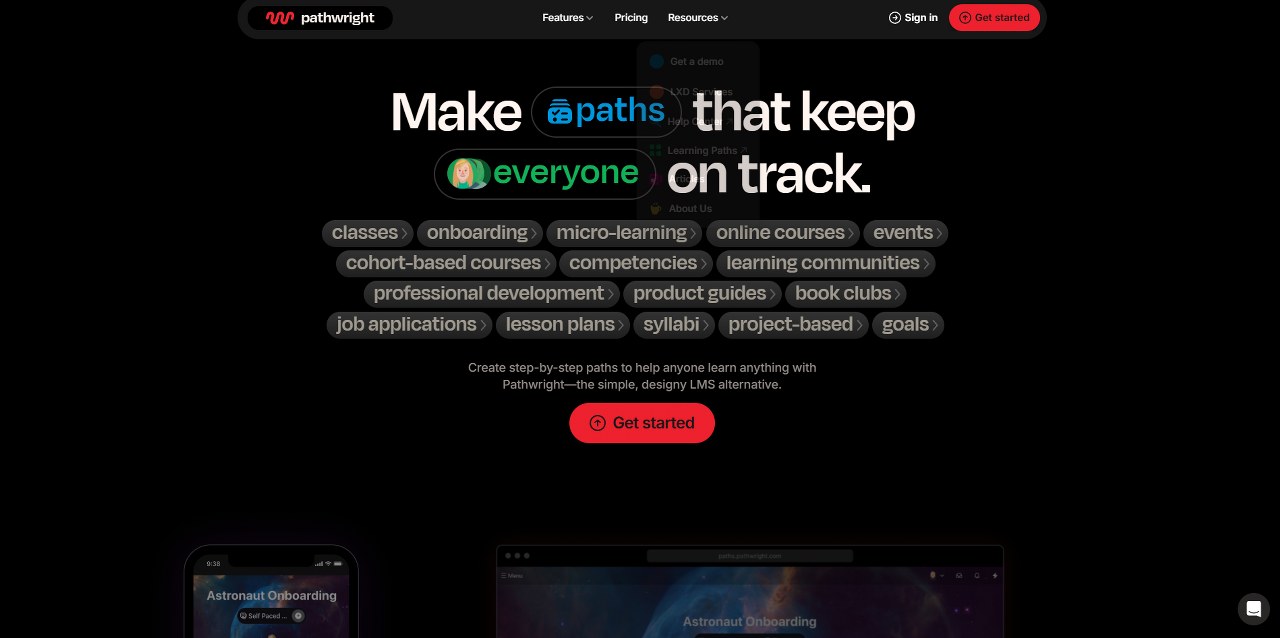
Pathwright focuses on courses that make everyone take action and community building. It offers a unique learning experience that makes students work together. Its features include:
Action-oriented learning: Pathwright’s design gives students the confidence to take action and apply what they learn.
Community-building features: It has tools to build a community for your students.
Personalized learning paths: You can create special courses for each student’s needs and goals.
Mobile-friendly design: The platform is easy to access on mobile devices.
Pricing: Pathwright plans start at $89 per month.
Ideal for: Pathwright is best for action-oriented courses and building a strong community. It allows you to offer unique learning paths for different people.
LearnDash is a learning management system (LMS) plugin for WordPress users. It integrates with WordPress to help you sell your course easily. Its features include:
Powerful course builder: LearnDash has many course creation features to help you build the perfect one.
Flexible and customizable: It’s easy to customize the platform to your brand.
Large community and support: You can get support from its large and active online community. Here, you can meet people to help you set up your business.
Pricing: LearnDash plans start at $159 per year.
Ideal for: LearnDash is ideal for those looking for a powerful and simple LMS solution.
Ruzuku is a simple platform that gives you a distraction-free environment. It’s perfect for instructors looking for a straightforward platform. Its features include:
Easy to use: Ruzuku has a simple interface. This is good for beginners to sell their courses.
Distraction-free environment: This feature helps you focus on your course content.
Built-in community features: Ruzuku has community features like forums and discussions to build student interaction.
Unlimited students and courses: Ruzuku’s paid plans allow you to reach unlimited students. You can also sell as many courses as possible, making it a profitable solution.
Pricing: Ruzuku plans start at $99 per month.
Ideal for: Ruzuku is best for instructors looking for a simple, distraction-free learning environment.
GoSkills Course Builder is a user-friendly platform that empowers businesses and educators to create professional training experiences without technical complexity. It’s designed to streamline internal training, onboarding, and skills development with ease.
Its features include:
Drag-and-drop course builder: Easily create custom training content with videos, quizzes, PDFs, and more—no coding required.
Brand customization: Tailor the look and feel of your learning portal to match your organization’s branding.
Progress tracking: Monitor learner engagement, completion rates, and certifications in real-time.
Interactive assessments: Create quizzes and tests to measure retention and reinforce learning.
Seamless integrations: Works smoothly with tools like Slack, Zapier, and more for better workflow automation.
Mobile-ready design: Courses are fully responsive and optimized for learning on any device.
Pricing: GoSkills’ paid plans start at $39 per month.
Ideal for: GoSkills Course Builder is ideal for small to mid-sized teams that need a scalable, hassle-free LMS to train, onboard, and upskill employees efficiently.
Choosing the Right Platform for You
As mentioned, selling profitable online courses depends on the platform you choose. But the best one is for you and what you prefer. You also need to consider your budget, technical skills, marketing goals and customizations.
You can try out different platforms before choosing the one that’s right for you. Good news is that some platforms have free plans where you can create an online course. Test the features of these platforms to see what’s best for you.
Teach Online Lessons on iTalki
Share your online knowledge through one-on-one online lessons on iTalki. Teachers earn $1,000-$3,000 monthly with flexible scheduling and no commute or classroom required.
Next step is to price the course you’ve created. You need to develop a pricing strategy and marketing plan to reach your audience. Setting the right price is the only way to launch your course.
Course Pricing
Pricing your online course can be tricky. This is because you want to make a profit but you don’t want to scare off potential students.
You can consider the following to get the right price:
Course type and format: The type of course you’re selling will determine the price. In most cases, short mini-courses are cheaper. This is because they’re shorter and easier to learn. Unlike comprehensive, multi-day courses or specialized classes. These courses are more expensive because they require time and effort to teach and learn.
Marketing costs: When pricing your course, consider the cost of marketing the course. This is the only way to make enough profit.
Expertise: Your level of expertise will also determine the value of your course. Experts with strong reputation can charge more for their courses. This is because people value their reputation in the industry more.
Research offline and online to know your competitors’ pricing before pricing your course. This will give you an idea of the market rate for your course.
Also, don’t price your course too low or too high. Pricing it too low can make it hard to generate enough revenue. Pricing it too high may make potential students lose interest.
Monetize Your Handmade Designs with Zazzle
Transform your handmade artwork into over 1,300 customizable products on Zazzle. Designers earn royalties of 10-15% on each sale, with top creators making $1,000-$3,000 monthly.
You need detailed marketing to attract potential students to your online course. Here are some promotion strategies:
Host a webinar: Host weekly webinars to showcase your expertise and connect with your students. This will also generate interest in your course.
Use email marketing: Email marketing is good for your existing audience. You can send regular newsletters to inform them about offers and upcoming courses.
Appear on podcasts: You can reach a new audience through podcasts. This is an opportunity to tell people how you feel. It’s a chance to share your experience in your field.
Use social media marketing: You can use social media platforms to connect with people and build relationships. You can also share valuable content and promote your new course on your pages.
Run paid ads: You can reach more people through paid ads on Google Ads and social media platforms. These ads can target the right audience for your course.
Use SEO tactics: Include relevant keywords on the course website and content. This will make you appear more on search engine results. It will also generate leads on your course landing page.
Build a content marketing strategy: Create valuable content to attract potential students and prove your expertise. You can create blog posts, articles and videos related to your course topic.
Try out different marketing channels to see what works best for your audience and course topic. Based on your results, you can always adjust.
Getting Feedback and Testimonials
Now that you’ve done all the steps, everything should be fine. But that doesn’t mean you should stop. You must get feedback and testimonials from your students. This is the only way you’ll know if your strategy is working. You need to keep doing this to improve and build credibility.
Getting Feedback
Feedback from your students is everything you need to improve. It gives you insights to their learning experience and highlights areas you need to work on. This will help you know how to create an online class that meets their needs.
Ask direct questions to encourage them to provide details about their experience. For example, you can ask, “What suggestions do you have for improvement?”.
This will give you useful information and ideas. You can also use video testimonials. These testimonials will add a human touch and make you look more credible. The best way to build credibility is by showcasing real students sharing their positive experiences.
Use the feedback to adjust your course content and improve the learning experience. You should also address any issues or concerns raised by your students. This will show your commitment to quality learning experience and build trust.
Why Do You Need a Website to Sell Online Courses
Creating your own website gives you full control over how you present and sell your online courses, so you can build a professional brand that attracts more students.
A website is your digital storefront, making it easier for potential learners to find your courses through search engines and social media sharing.
To ensure your course platform runs smoothly and loads fast for users worldwide, investing in the best web hosting is crucial as it provides the reliability and performance needed to deliver high-quality educational content.
Creating and selling an online course makes you money. But that’s not the only benefit you get. You get to teach other people and feel good from sharing your knowledge.
Everything in this article will help you make a successful online course and impact lives. Remember to always create high-quality content and choose the right platform.
Tip
Make this a priority for any other courses you create in the future. While at it, you can also learn how to make money without a job for extra income.
Selling an online course starts with a website that’s built for learning, engagement, and seamless transactions. Explore our recommended website builders to launch a course-ready site that showcases your expertise and helps turn knowledge into income.
Choose a profitable topic based on trends or your interests. It should also be a course that solves problems for your students.2. Outline your course content into modules and lessons. Choose the right content format for each lesson.
Create high-quality video lessons with engaging scripts, good lighting and no background noise. If using slides, keep them short and attractive.
Choose a platform that fits your needs and budget to host your course.
Set the right price based on competitor’s pricing and your course value.
Create a sales page to reach potential students.
How much does it cost to create an online course?
The cost of creating an online course varies. You can spend less using basic equipment like your smartphone, free software and free plans on a course platform. You can also spend more using professional video production, course website design, premium platform features and paid advertising.
Do I need an LLC to sell courses online?
No, you don’t need an LLC (Limited Liability Company) to sell your courses online. However, your situation may require one for the safety of your online business. It would be best to talk to a legal professional to know what to do in your situation.
Can I make money selling online courses?
Yes, you can make money selling online courses to people. However, your income may be higher or lower depending on several factors. This includes your course quality, marketing efforts, pricing strategy and market demand.
Some course creators earn enough to meet their needs. Some others earn up to six or seven-figure income every year.
Can I pay someone to create an online course?
Yes, you can pay someone to create an online course for you. In fact, it would make your business easier when you don’t have the time, skills or resources. You can hire people to create content, develop courses and design your website. There are also professionals to help market your course for a fee.
How much does Udemy pay to instructors?
Udemy pays instructors differently. The share model depends on how the student found your course. They may find it through Udemy’s marketing, your marketing efforts or an affiliate link.
You can earn a higher percentage (up to 85%) when a student buys your course through your marketing efforts. But it will be a lower percentage (as low as 3%) when Udemy uses its marketing channels.
HostAdvice.com provides professional web hosting reviews fully independent of any other entity. Our reviews are unbiased, honest, and apply the same evaluation standards to all those reviewed.While monetary compensation is received from a few of the companies listed on this site, compensation of services and products have no influence on the direction or conclusions of our reviews. Nor does the compensation influence our rankings for certain host companies.This compensation covers account purchasing costs, testing costs and royalties paid to reviewers.